
Toccara Huckaby: Expert Spotlight Throwback
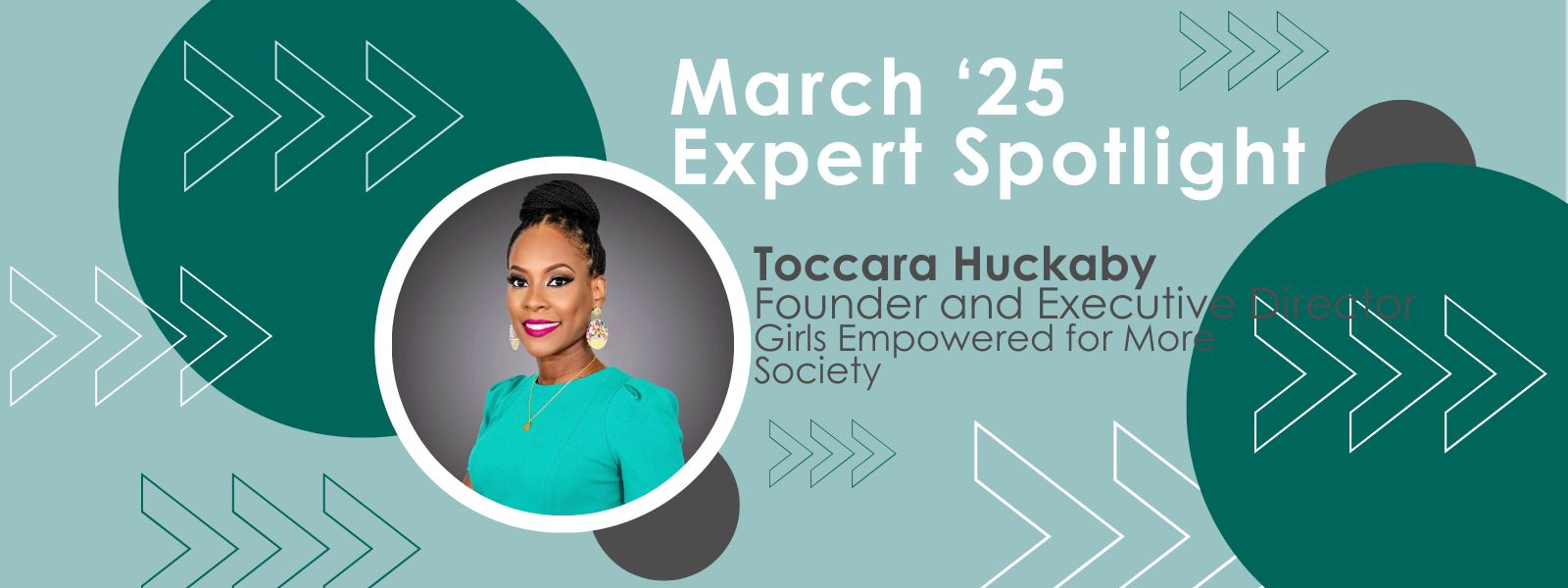
We're thrilled to introduce you to Toccara Huckaby, a powerhouse educator and entrepreneur whose dedication to empowering young minds shines brightly. From her early days as an award-winning teacher, where she earned the title of Middle School Teacher of the Year, to her leadership roles in afterschool programs and her entrepreneurial ventures, Toccara's journey is a testament to the transformative power of education. Her commitment to fostering excellence, coupled with her passion for creating nurturing and empowering environments, has driven her to develop impactful programs and initiatives that truly make a difference.
Toccara's deep understanding of the needs of students, particularly young girls, has fueled her drive to create innovative learning opportunities that equip them with the skills and confidence to thrive in a rapidly evolving world. Her work with Girls Empowered for More Society, Inc. (G.E.M.S.) and her vision for Merit Girls Academy demonstrate a profound commitment to addressing the gaps in STEM, leadership, and entrepreneurial education. In this Spotlight, Toccara shares more about her upcoming project of opening an all-girls academy focused on delivering high-quality experiential learning rooted in STEM and entrepreneurship, and she is actively looking for partners to bring this vital vision to life.
What does Experiential Learning (EL) mean to you, and why is it important? What would it look like to truly learn experientially? I think Experiential Learning isn't just the buzzword that we throw around. It represents a fundamental shift in our approach and our approach to education. To me, it's about providing students with real-world experiences, that are truly real and relevant, and allow them to apply their knowledge in meaningful ways. Growing up in a low-income family, I often felt conventional education failed to really connect with my experiences. So it's crucial to me to foster those critical thinking, creativity and problem solving skills and abilities that are essential for today's world.
In thinking about this, truly learning experientially would really involve students engaging in those hands-on projects that actually address challenges within their communities. Imagine being in a classroom where girls are not just reading about environmental science, but they're actually in the community doing cleanups, and they're actually out working with local scientists, and they're actually working on developing sustainable solutions. Experiential Learning means creating those types of immersive learning opportunities that really deepen the understanding for kids, and not only that, but it also empowers them and allows them to see themselves as leaders and as change makers.
What do you believe is the best first step towards advancing the future of learning? What is necessary to make it successful? The best first step is to dismantle the outdated structures in our educational system. We cannot continue doing the same thing and expect different results. It's time to embrace innovation and reimagine what school looks like. If we don't invest in teachers, through professional development and training on project-based and experiential learning, we'll keep getting the same results. We must prioritize curricula that aligns with this, removing and replacing what we need to move forward.
We also need to prioritize equity, ensuring all students have access to quality educational experiences every day, regardless of their background. This involves engaging families and the community, sharing how this shift will impact our kids down the line. We must invest in exposing children to beneficial experiences that prepare all students for success.
Who is the most influential mentor you have had throughout your life? What qualities did they impart that you continue to embody in your work? I will say I have had several mentors over the course of my life that stand out. But first, I have to acknowledge my mother. She was my first mentor. My mom was not a lovey-dovey kind of person at all, and she was not one who said 'I love you' all the time, however, she showed it. She also ensured that she poured into us the value of education and demonstrated resilience. My mom worked as a housekeeper until she was able to finish nursing school in her 30s. In addition to that, she was really the epitome of an Experiential Learning teacher. She showed us how to write a check. She would let us go into the facilities to pay bills for her. She would allow us to go shopping for groceries and she would sit in the car while we went in with a certain amount of money and use that list to be able to go in and purchase groceries for our family. She walked us into the bank to show us how to open a checking and a savings account. She made sure that we could do those things, and with that to me, it taught me a sense of responsibility, but it also empowered me, because now, when I walk into a facility, I know how to handle business. It's not necessarily because of the things that I learned in my classrooms. It's because my mom understood the value of doing. She was definitely my initial mentor.
I had a teacher in first grade, Miss Helen Lee, who would allow me to come in and check papers for her in the mornings when the kids were outside playing, because I told her I wanted to be a teacher when I got older. She would allow me to come in and check papers. I thrived in her class. I felt like she saw me, and I felt like she knew that I had something valuable, and she did things to really spur me on.
Miss Lisa Cooper was my ninth-grade language arts teacher, and she was a teacher who showed me how to exemplify empathy. We had a big test on To Kill a Mockingbird. We were supposed to go through, highlight things, mark it with notes, and then we could use our book for the test. That morning I was in such a rush and so nervous about it. I left my book at home sitting on my nightstand. I came into her classroom, and she started to pass out the test, and I just broke down in tears. She saw me, and she looked and said, 'What's wrong?' I said, 'I forgot my book,' and she didn't make a big deal of it. Didn't go 'you should have…' None of that. She went to her desk, got her book that was filled with her notes and her marks, and she sat it on my desk. I can't tell you how much that meant to me because to fail that test, for a person like me who really wanted to do what I'm supposed to do, that would have just really crushed me and just added added stress to me. For her to do that for me, it just showed sometimes you just have to help. You just have to put yourself in that position of, 'How would I feel if I was in this space, and if I needed support at this time?' That's what she did, and not only for me, I saw her do it over and over again. That's a piece that I try to carry into the work that I do, just being empathetic. And 'How would you feel if you were in those shoes, and what would you want and what would you need?'
What is the hardest decision your organization/school has had to make recently? What recommendations do you have for evaluating the tradeoffs involved in this type of decision making? I'm going to answer this question from this perspective -the hardest decision we will have to soon face is whether to expand our programs, to reach more girls, or to deepen our existing offerings. On the one hand expanding would allow us to serve a greater number of girls and really fulfill our mission. But on the other hand, spreading ourselves too thin could possibly impact the quality. Next month will be our one year anniversary of our first program so because GEMS is new we understand that we'll have to evaluate the trade offs and conduct some needs assessments.
We will need to consider both the quantitative and the qualitative data from our current participants to understand what the needs are. We still need to continue certain elements and gather feedback on which programs were most impactful so that we can make some decisions going forward. As the founder, I sat down to develop what I thought our programs should look like and so sometimes it's hard to let go of what you think is a good program. But sometimes you have to make those tough decisions in order to ensure that you're meeting the needs of the kids that you're serving.
What is a student-led initiative you have seen that has successfully disrupted a flaw in the education system? How can we best position students to be changemakers? Just before COVID, I was a part of a group that helped to develop a teen advisory council. This group was a collection of students from schools all throughout the school district, and the students were meant to take the lead on addressing the lack of mental health resources at their schools. And so these students had to organize a campaign advocating for the establishment of a mental wellness meeting. During the meeting students were surveyed and the teen advisory council organized workshops, discussions and panels to provide resources to the students. This was truly a student to student kind of thing, and to see the kids take the lead from getting the speakers organized to ordering lunch, seating at the meetings, field trip forms that needed to go out, they took ownership of every aspect. They literally took the lead on it all and as adults, we were just supporting them. We were there if they had questions, but they did it all and they did it well. It really was eye opening.
What is an EL-based initiative that you are the most proud of and why? I'm most proud of our upcoming initiative through a partnership that we've established with Technovation, an organization that empowers girls to create technology based solutions to problems like poverty or climate change and limited access to education. The program not only introduces technical skills, but it also encourages them to work collaboratively on projects to address real-world problems. They get to design an app that helps to solve a problem in their community.
During the summer last year, we started what's known as our 5G, Growth Mindset Camp where girls are taught that their brain is a muscle, just like any other muscle in their body, and it can be strengthened and can be developed. What we've learned through that research is that most times when girls get into sixth and seventh grade, they tend to believe that they cannot do STEM based things and they think it's more so for boys. We typically want to serve fifth and sixth graders before they're moving into that space, they can come to our camp, and learn about their brain and how they can strengthen it. With the added Technovation piece, we're adding an opportunity for girls to actually work with technology to develop a solution to a problem. This is going to be a way of enhancing that camp.
What drew you to your organization's mission? What drives you to activate this vision? I have always had a heart for seeing girls thrive. I was drawn to our organization’s mission because I deeply understand the barriers that girls face in accessing opportunities in fields in which they historically underrepresented, and this is even more true for brown and black girls and for girls from low income households. I believe in the power of education to transform, and I am driven to create pathways for young women to explore their potential.