
Dr. Adrian Haugabrook: Expert Spotlight Throwback
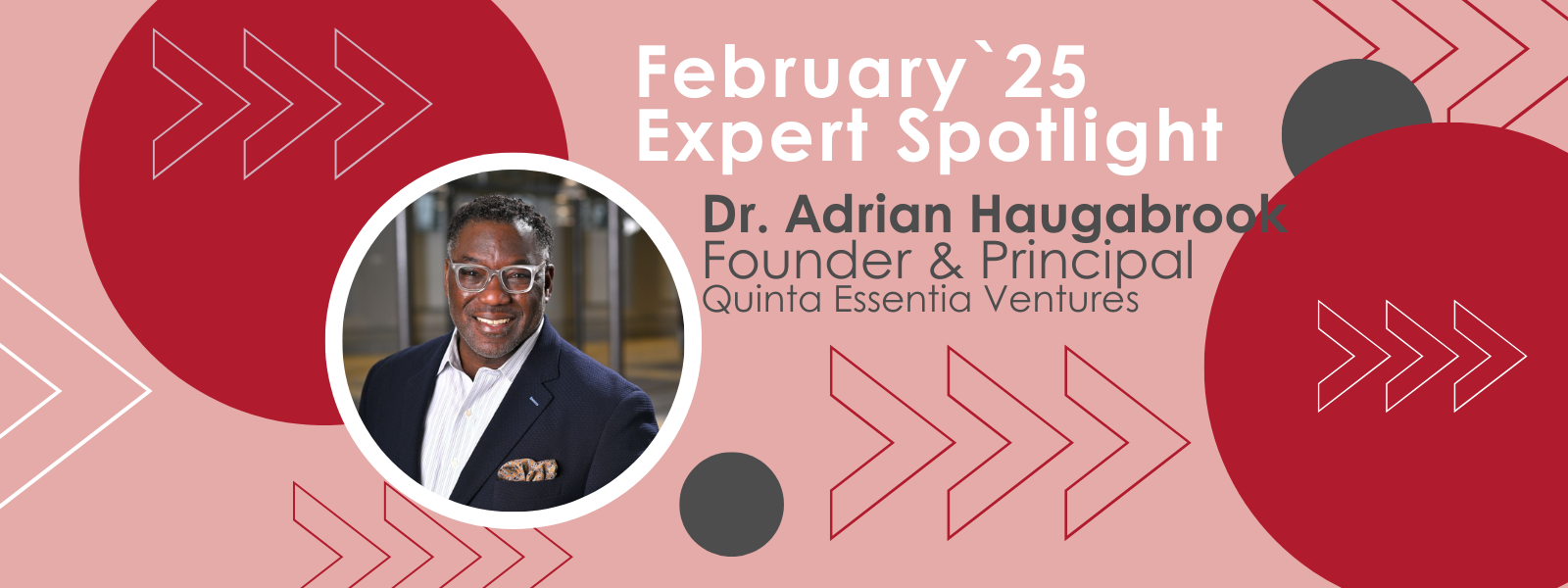
We had the pleasure to sit down with Dr. Adrian K. Haugabrook, a true innovator in the field of education. Dr. Haugabrook is a Citizen Schools alumni where he served as a member of the Founding Leadership Team as Director of Citizen Schools University then Executive Director of Public Policy, Alliances, and Innovation. He has dedicated over three decades to influencing access, equity, and opportunity, and his passion for transforming education remains as strong as ever.
Today, as Founder and Principal of Quinta Essentia Ventures, he empowers social sector organizations to achieve greater impact through strategic capacity-building and innovative solutions. His extensive experience includes serving as Executive Vice President and Managing Director for Social Impact at Southern New Hampshire University, where he championed equity and social mobility through groundbreaking initiatives like competency-based education. Dr. Haugabrook continues to shape the future of education through his leadership on the boards of Upswing International and Complete College America, and we're excited to share his insights on the evolving education landscape.
What does Experiential Learning (EL) mean to you, and why is it important? What would it look like to truly learn experientially? When I think of learning and development models, I think of the word itself, and the root of that word. For Experiential Learning, I think of experience as being the root, or in the Latin it would be experientia, meaning knowledge gained by tests or trials. So when I think about Experiential Learning as a modality of knowledge gained by testing and trials, it is actually engaging in those experiences that translate that knowledge into some particular outcome.
Having those experiences means that you develop the agility and the adaptability for how to apply that learning differently. One of the things that was beautiful for me to see when I was part of the Citizen Schools ecosystem and environment was the student showcase. It was the demonstration of that learner's capability and capacity to actually deliver on what they know. It was about the actual demonstration of what they could do.
Focusing again on this definition of knowledge gained by testing and trials, we also understand that not every experience turns out to be a plus. An impactful part of Experiential Learning is that you also learn from the things that don't turn out the way that you had expected. When you think of all the science experiments that you may have done, not every one of those resulted in what it was supposed to. Then you went back and you were trying to discern what needed to change for you to get the intended result. I think about this element of Experiential Learning as a foundational way of learning because it also encapsulates the different ways of learning.
Another key aspect of Experiential Learning is that the learner can be the facilitator of their own learning. It is about the demonstration of skills and therefore agnostic as to how you develop those skills. The demonstration of those skills is the threshold. So it doesn't matter if you learned computation in an accounting class or because you were a floor manager at a retail store or because you were a caretaker at home and you had to calculate the correct dosage of medicine to administer. It's the demonstration of that skill that results in mastery which creates agency.
From my time at Citizen Schools until now, my work grew from Experiential Learning into competency based education. Experiential Learning is a key part of competency based education but with key differences. Experiential Learning is learning through experience and reflection, and competency based education is about mastery of skills and competencies. With Experiential Learning, you learn by doing, and you keep doing. With competency based education, you learn by doing until you reach a level of mastery. That brings you to the assessment piece which is also different. With competency based education the assessment is an actual demonstration of mastery. As an example, you don't just reach Black Belt and then say, look here's my black belt, right? You actually have to show that you are a black belt.
Lastly, competency based education is self paced. Mastery is not dictated by a timeline, such as a semester, so it's self paced in a structured way led by clear skills and definitions of competencies, which are mapped to learning objectives and learning goals. So skills become the currency, not just credits.
*To hear more about Dr. Haugabrook’s thoughts on lowering the barriers to higher education, please listen to his 2021 TED Talk.
What do you believe is the best first step towards advancing the future of learning? What is necessary to make it successful? When I think about the future of learning I think about understanding the learner and where the learner is, putting the learner at the center and focusing on the ecosystem that supports learning. When you think about experiences, they are not confined just to a classroom which means that a learner does not need to be in a classroom to learn. It's not just about digesting the content and understanding it, but it's also translating that understanding into some degree of application. Similarly, when you call someone a student that’s kind of a way of saying there’s something different about them. But when we say understanding someone as a learner you're removing the objectification, and you're putting people in places exactly where you are. We’re all learners, and learning environments can be set up all around us. To support learners at the center of their learning environment, there is a second part which is focused on the ecosystem that surrounds that learner. What are the structures, systems and supports that are needed to allow for agility, growth, learning and development to occur? What are those kinds of structures, systems and supports that allow for experiences to be had and experiences to be imagined?
There are four elements that I consider part of the future of this learning paradigm. I think about all four of these as both inputs and outputs because they inform the support and conditions for the learner, but can also become the impact. First, I think of quality of life. Then, I think about civic and social engagement. Next, comes mobility, specifically upward mobility. Finally, I think about work, or the future of work for that learner. I make this distinction because work can be a pathway in all of these things and we should think about not just current work but future work for our learners. If we're building true experiential and competency based learning environments, then it's all about skills and competencies. You're future proofing their livelihoods, which includes continuing to grow and develop the skills that are needed for the world that is, and in the world to come.
Who is the most influential mentor you have had throughout your life? What qualities did they impart that you continue to embody in your work? That group for me is essentially all of my teachers and all of my coaches. Those weren’t always formal designations but rather made up of Big T, Big C, little T, little C, teachers and coaches, and I apply those titles because those in this group understood how to create the environment or experiences for growth and development. Those coaches and teachers put me at the center of their sort of pedagogy. As a result of that, I learned how to put others at the center.
There are five takeaways that this group instilled in me. First is being able to have a sense of agency and self advocacy about how to learn and that learning is fun. These teachers and coaches taught me that even in challenging situations, you have to keep learning from them, whether it's a plus or delta.
The second takeaway for me is the discernment of capacity and capabilities. One of the reasons for my athletic success came from my ability to understand what my capabilities were, which then translated into what my capacity was. Realizing that I was not the fastest meant that when playing against teams who were faster, I had to understand how I thought strategically would put me in the places where I needed to be, in situations where speed outright wouldn't do it for me. My capacity was limited in that way, but my capabilities were expanded in other ways.
The third thing was that there was always a measure and an understanding of progress. As a result, I've always been that kind of instructor who was really about, what is the difference between where you started and where you are now. When you apply this to competencies, or Experiential Learning then you grow and develop towards skills and build towards understanding your own progress.
The fourth takeaway is that these coaches and teachers helped me to understand what is good, what is successful, and what is excellence? And further to understand when it's okay to be good, when it's okay to be successful, and what requires excellence.
And then the last takeaway that I have is that they taught me how to coach, how to teach and how to mentor towards skills, experiences and competencies.
What was your earliest experience with hands-on learning? Did that inspire what you do now? My earliest experience with Experiential Learning was being an athlete. There's not a single day that goes by that I don't think about my academic life, or my journey of being a lifelong learner, being an athlete in school and beyond, and thinking about my professional life. These three areas can be very similar because you grow by demonstrating your ability to do things. I'm constantly thinking about the experiences that I've had in each of these three domains that allows me to progress in one or the other. If you play a team sport, or participate in a team activity you understand that you have a role, the person next to you has a role, and those roles may be very different. But you are collectively trying to achieve a certain task or set of objectives together. When you think about that from a team perspective, then you understand that you have to be able to understand, know, do and achieve, and that your abilities to be a master of something may not be the same given the environment that's happening. So you have to ask yourself: How do I rise to that occasion? Is it a skills question? Is it a competency question? Is it a question about adaptability?
My earliest professional experience with Experiential Learning was at Citizen Schools. I still remember running my first student showcase. It was a group of students at Walsh Middle School in Framingham and they developed a diversity training program for executives at the TJX companies, which included the CEOs of the subsidiaries and VPs. I had one of the VPS come up to me and say, “I thought I was coming to this session because the CEO made us but I truly learned from these middle school students.” It was phenomenal.
What are some of the greatest inspirations you have in the field of Experiential Learning? One of the greatest inspirations that I've had is moving from Experiential Learning as the foundation to competency based education and then seeing competency based education, and refining it and leading it across the globe. From here in the United States, to refugee camps in South Africa, to East Africa, the Middle East, and seeing agnostic as to the who, or the what, it was the experiences, and being able to translate those competencies into real things.
I remember when I was visiting South Africa during my time with Southern New Hampshire University, and I was visiting with students who had participated and earned their degrees through our competency based education model at the time. They could tell you what particular project they took from that work and how they translated it into their business. How that affects the work that I do now, I realized as a consultant that I spent much of my career building and doing, and now the focus of my journey is helping to build sustainability and growth in organizations that are actually part of that learning environment. I partner with those who are setting the conditions for the very learners that we're talking about. From work like what Citizen Schools does in working with learners, to ed tech companies who are reframing how they think about technology, they are all a part of an ecosystem. If you are building a solution that creates barriers to learners accessing the rest of their ecosystem, then you're actually not doing a service. This all translates into the work that I get to do now, working with mission oriented organizations that are really dedicated to understanding how social innovation can create huge social impact.