
Dr. Liz Whitewolf: Expert Spotlight Throwback
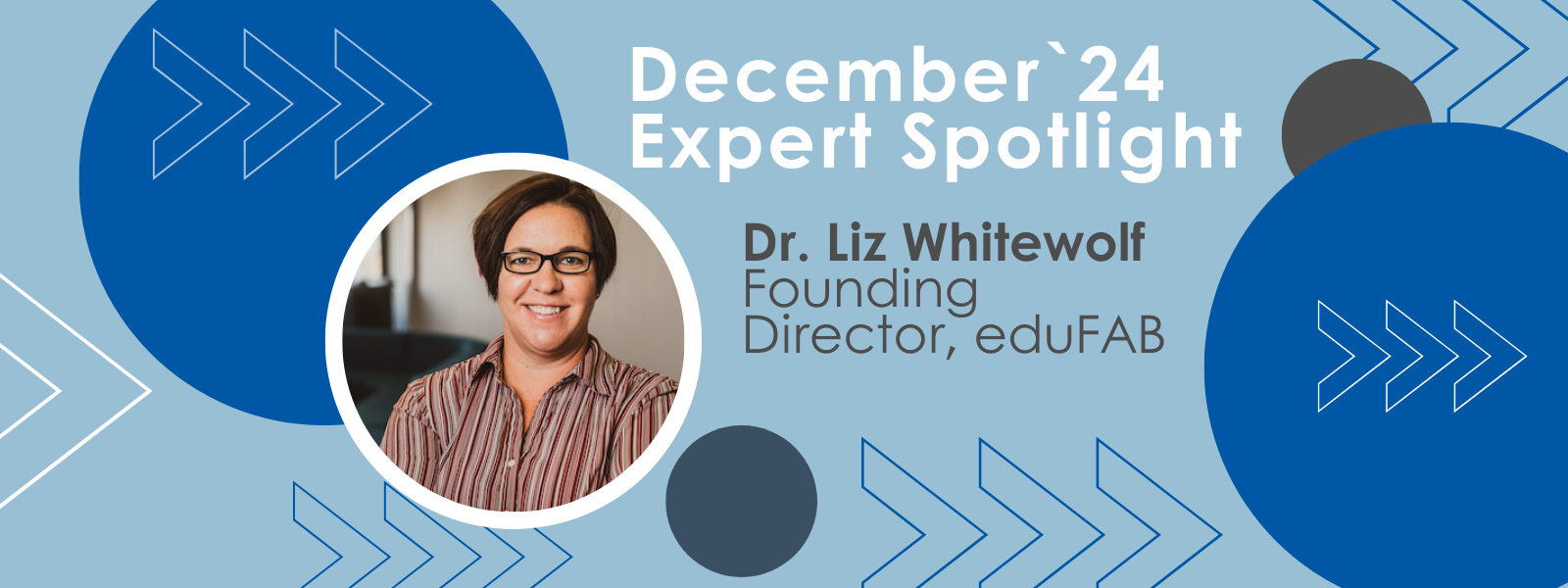
At the end of 2024, we sat down with an amazing member of our Learning Network community, Dr. Liz Whitewolf. Dr. Whitewolf, the Founding Director of eduFAB, is an innovator in the field of education who is passionate about incorporating experiential learning and Making into the classroom. Citizen Schools had the opportunity to collaborate with Dr. Whitewolf during her time as the Senior Director of STEM Education at the Carnegie Science Center. She was instrumental in developing the Fab Learning Academy provided professional development for international educators, equipping them with the skills and knowledge to integrate Making and experiential learning into their teaching practices.
Citizen Schools is thrilled to have Dr. Whitewolf as a valuable member of the Learning Network community. Dr. Whitewolf's work centers around empowering educators to create engaging and impactful learning experiences. Her dedication to hands-on learning, combined with her deep understanding of the learning sciences, makes her a leading voice in the field of education. In this interview, Dr. Whitewolf will share her perspective on the importance of experiential learning, the role of Making in education, and the best strategies for advancing the future of learning. Her insights will undoubtedly inspire educators and thought leaders alike to embrace innovative approaches that foster student growth and engagement.
What does Experiential Learning (EL) mean to you, and why is it important? What would it look like to truly learn experientially? I think that Making in itself is experiential and always has been and people have been Making in school forever. Kindergarten is basically a maker class, and students learn so much. I remember my kids bringing home their crafts and things, showing them to me and explaining what they learned. They are presenting their learning, which is project based learning because they're sharing how they learned it. Then if you ask the right question, they can reflect on their learning journey.
It seems like every subject in the early grades has the opportunity to be experiential through Making, and then those types of projects disappear as they advance in school. Making in school either goes away entirely or is sequestered to its own art or engineering course. We do such a good job when the kids are younger with experiential learning through Making, and these opportunities could increase with digital fabrication as students advance in school. My take on digital fabrication in education is that it supports experiential learning while integrating technology and other STEM competencies.
What do you believe is the best first step towards advancing the future of learning? What is necessary to make it successful? I would prioritize bringing tools like 3D printers and laser cutters into the classroom to be used as instruments for learning content. Instead of bringing your class into the Makerspace for an activity, bring the tools into the classroom for students of all subjects, not just the ones who have an elective open for the Makerspace class. As the price of these tools comes down, this will hopefully become more common in classrooms, just like computers eventually moved out of the computer lab and into the classroom.
For a lot of US classrooms, teachers are already integrating technology through computer based apps, websites, and AI. One obstacle is not every school has the same outlook about how computers are used. Just because a kid has an iPad at school doesn't mean that they're experiencing technology in a way that will enhance their learning, they may just be reading textbooks on it. So really challenging us to use technology in a more creative way that supports learning. Another challenge for teachers is if they have to learn a new technology and then embed it into their lesson plan the next day, it is a huge challenge. Where's their comfort level? Are their kids comfortable with the technology? So understanding can your kids type, can they download and upload files, those types of things to start.
Teachers don’t get a lot of support for that. A lot of schools don’t have a scope and sequence for technology literacy yet we have a very structured way of teaching how to read and how to do math. A teacher may get to class and be so excited to try this new technology but then it takes 50 minutes for everyone to sign on to the website. So for a teacher thinking about how can I use this technology in a more creative way, you really have to think about where's my comfort level with the technology, where's my kids comfort level with the technology and go from there.
This is something I've been thinking about a lot lately, because I'm working on a STEM skills teacher curriculum course for the Middle East and North Africa (MENA) region. It is a moment of reflection because whenever I do STEM training, there's a significant emphasis on technology and Making, yet some stakeholders, like in the MENA region, don't have the technology that we have. I'm really thinking about what is STEM without high technology? How can I think about technology in a different way?
Some of these teachers have shared that they have an overhead projector, so we need to think about whatever technology teachers have available and kind of flip it and find creative ways to use that with your students in a Making project. You can put your lecture on the overhead projector or you can use it for tracing images, or creating a shadow puppet show. It’s about using the technology in support of experiential learning, even if it’s pretty low tech, so I have to meet the teachers where they are.
Who is the most influential mentor you have had throughout your life? What qualities did they impart that you continue to embody in your work? Though I would not have been able to reverse engineer the career that I have now, I think my parents set an example for me about the growth options you have throughout life. My dad went back to school when he was in his 50s to get his master's in teaching. He went from being in broadcast news to being a teacher and I was like, wait, you can go back to school? I did the same thing and went back to school and pivoted my career. And then my mom stayed at home with us until we were in school and then decided she needed to have something of her own and she started her own career as a real estate agent. This gave her flexibility and she was in charge of her own schedule, she could take calls when she wanted to and she was able to be there for us while having this whole other life and creating her own way. I was able to see as a young kid that you don't have to just be in one job for your whole life. You really can do what you want to do and not approach it from fear but instead from an opportunistic standpoint.
Then as an adult, I was getting to be where I really started to have experience, and was getting good at what I was doing, which was Making with teachers or teaching teachers how to teach with Making. I also started trying to create a network of support and work on some international projects. It was important to me that everyone could contribute to the work, but it was taking a long time to make decisions. There was a young woman that joined this group and she once said to me “Liz, you're an expert in this, why don't you take a little bit more space in these meetings and lead?”. And I was worried because I wanted everyone to feel empowered in the network but she pressed on and said “we feel empowered, but also we've been spinning our wheels on this project for a while because nobody's willing to take that step and you're the most qualified, you're convening these meetings, why isn't it you?” And I had this moment of wait, yeah why isn't it me? I can do both of those things. I can lead this group and I can make everyone's voice be heard. I don't have to wait until somebody gives me permission to take that leadership spot, I can give that to myself. That has really changed the way that I work. I don't want to say that I take control of every situation, but I feel empowered with what I can do, but also how I respect others. I can take up my own space and let other people take up space. I don't have to wait in the sidelines until there's an opportunity for me to chime in, which is what I did for a long time in my career. And now that's something that I'm really trying to teach my daughters. It changed my life, the way I think about how I interact with others, and how I create my space, and I take up space.
If no obstacles stood in the way and you could design the future of education as you see fit, what would that look like for educators and students? I think the idea of a lifelong learning continuum for kids and being able to appreciate learning experiences that aren't in formal education and get credit for them would be revolutionary. I hate to say the term badging, but that's shorthand for what I mean because they're taking these after school programs, or they're learning something at home with their parents, or they're working in a restaurant, and that is learning. That's experiential learning, but it's just not counted in our formal education system. If there were a way to make all of that count, because they're in school, and then they go somewhere else. What do they do when they go somewhere else? What are they learning? And is that relevant? I believe most of it is pretty relevant.
As an example, if you are learning time management and memorization skills, all the stuff you use when you wait tables for a living or you are participating in an after school robotics program, and learning similar skills, then we are leveling these experiences as equally important for the development of that child. Some people will call it hacking education, but generally giving students the opportunity to pull from what they do and identify the learning in it. I think culturally relevant teaching and learning is a step towards bringing those lived experiences into the classroom, but it still doesn't go far enough in crediting these out of school time learning in the same way. It’s about respecting those outside experiences as learning and development for each student.
And then this other component of self driven inquiry learning. I love seeing videos of kids who have been able to kind of choose their way through education, though there are few. It’s not something that every kid feels empowered to do, and our systems aren't set up for that. The only kind of choice that kids tend to get in grade 6-12 is their after school activities. This may be the only place where our kids get to choose what they want to learn. And for parents, understanding your kid as a learner versus your kid as an athlete or participant in a club is super important, because your kid is learning so much in their activities. If you think of your kids as learners who are playing a sport, or doing an activity, it's a totally different approach and contributes to the journey to be a lifelong learner. If parents can recognize these as learning opportunities, the next step is the administration!
What is an EL-based initiative that you are the most proud of and why? I am really excited about the International Fab Educators Summit, which we started in 2022 to connect teachers across the globe who are using digital making with their students. It is a solid 4-hour virtual event that features practitioners in the network in workshops and inspirational talks. Teachers share projects, challenges, successes, and innovative solutions for other educators, it is a really great way to make connections and to get inspired by colleagues who are working towards the same goals, just across the sea, or across the border. The Fourth Annual International Fab Educator Summit will take place on January 31, 2025, and will be our biggest yet. The Summit started in 2022 and really relies on teachers across the world to share with other educators, specifically around digital Making and Maker education. Community members present to each other about what they're doing in the classroom and it's very practitioner focused. So whether that classroom is in the United States or in Bhutan the question is the same. What are you doing with those students and how is it affecting their learning, or your experience of their learning? It is really amazing to me to see what the community has to offer and all the pockets of expertise we have. Being able to talk with people who are in the same boat as you are but in a different country, and you’d never see them in any other setting is pretty amazing. We're so different across the world but teaching and learning is the same because it’s about that relationship happening between teacher and learner. And so it's amazing to see that and to see the creative ideas and the questions that come out, and where the students are taking things or what the students are learning in different settings. Building this community of educators is important to me because we're all trying to figure it out and you don't have to figure it out alone. We are all trying to make those important connections that we call education.