
Liza Littenberg-Tobias: Expert Spotlight Throwback
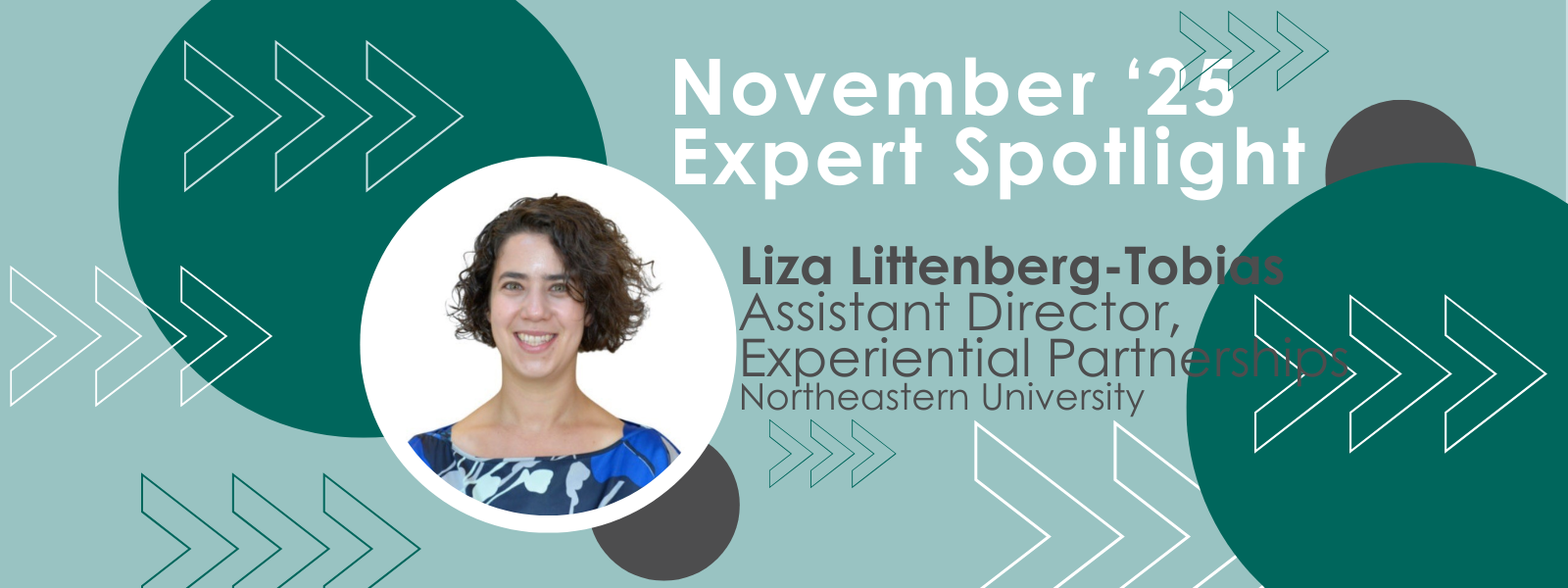
We are thrilled to shine our Expert Spotlight this month on Liza Littenberg-Tobias, a recognized leader in the field of innovative education and the Assistant Director of Experiential Partnerships at Northeastern University. Liza leads a pivotal team tasked with designing virtual, real-world learning experiences that effectively bridge classroom theory with professional practice. Her work is central to advancing Northeastern’s reputation as a thought leader in experiential education, as she recruits industry partners to develop authentic project opportunities that benefit students, faculty, and sponsors alike. Liza’s profound expertise lies in tailoring Experiential Learning (EL) to meet the specific needs of diverse learners, from middle school students to graduate candidates, ensuring that every student receives the crucial, hands-on exposure necessary to shape their future careers and broaden their imaginations.
For Citizen Schools, Liza’s selection holds special significance as she is a cherished alum and Champion of our organization. Liza credits her early career experiences with CS - from forming life-long friendships to learning the ins and outs of team management in leadership roles - as the catalyst for her professional trajectory. Her powerful commitment to educational equity, stemming from her upbringing and demonstrated by her work to ensure EL opportunities are accessible to all students regardless of background, directly aligns with the CS mission. Her passion is driven by a firm belief that providing all students with early, hands-on job experience is the best first step towards advancing the future of learning. Through this spotlight, we celebrate Liza’s journey from a CS participant to an innovative leader and look forward to sharing her valuable insights on what it takes to make Experiential Learning a successful and transformative "at bat" for the next generation.
What does Experiential Learning (EL) mean to you, and why is it important? What would it look like to truly learn experientially? Looking at the trajectory of my career, when I think about Experiential Learning, I first think about who is the audience for Experiential Learning? During my time working at Citizen Schools I was working with middle school students, then at Excel Academy Charter Schools I worked with high schoolers now I work in higher education. With each student group there are very different needs and levels of independence so Experiential Learning looks really different. Project Based Learning has such meaning for younger students where there is a concrete project that is their entry point to Experiential Learning. Students need something that they can feel and touch so the physical nature is important. High school students need more independence. They can think about what it is that they are interested in and can use Experiential Learning as the mechanism to discover interests. For undergraduate and graduate learners, it is more about supporting them to prepare for their futures. Experiential Learning for them becomes a tool for them to progress. So I believe it all depends on who you are looking at and what their needs are at the moment.
As a mom of a 10 and 7 year old, I also think about their Experiential Learning especially in their extracurricular activities. When my kids come home from school excited and energized it tends to be related to something new and different. These new experiences break the mold for them and get them out of the monotony of their routine and sparks something in them. This is when I notice they start to make connections with what is happening outside of school. My younger daughter was learning about the community and they were talking about individuals who are unhoused. As we were driving around she started to notice individuals at stoplights asking for money and wanted to learn more about how we could support them. To see the connections that kids make at this age is so interesting and it starts with getting them to make connections via experiences.
What do you believe is the best first step towards advancing the future of learning? What is necessary to make it successful? I firmly believe that the thing that we need to do is give high school students hands-on job experience. When I was working at Excel our students would work, volunteer or participate in summer programs. Being immersed in these experiences changed how they thought about their futures. There is no way to replicate the experience of doing the work and we are missing the mark by not giving kids exposure to what jobs really are. We can teach them about the different kinds of things they might do in their future, but unless they live it and get to see what it is actually like, we are doing them a disservice. If students don’t get to see what is fully available to them, their imaginations don’t get broadened.
The other piece is providing opportunity to all students. At ExceI I built partnerships with organizations doing incredible work with youth. Many of these organizations focus on recruiting high achieving engaged students which makes sense because those students have worked hard and deserve every opportunity. However, there is a gap in providing opportunities for students who may be disengaged from school for a whole host of reasons, one of which could be that they don’t see a future for themselves. What if we gave them the chance to see what was possible through these opportunities as well - how would that change their trajectory. We need to provide more opportunities and earlier on. One of the things I remember fondly about Citizen Schools is our students were able to visit Google and Microsoft and law firms. They got to leave their neighborhoods and be part of this vibrant work community and saw the opportunity. There is no way to replicate this in the classroom. You hear kids talk all the time about how they are never going to use their math and science skills, so let’s give them experiences to see the opportunities you need those skills for and see if they feel the same way.
Who is the most influential mentor you have had throughout your life? What qualities did they impart that you continue to embody in your work? This may be super cliche but I think about my parents. I think about the work that they do first. My mom is a clinical psychologist and her work started with a focus on serving low income women in Somerville who didn’t have access to mental health care. My father is a professor at Northeastern who studies the environmental impact of disease. He works with organizations to study how predominantly low income communities of color are impacted disproportionately by environmental disease. For example, a lot of the recent PFAs work in water has come out of his work with his colleagues. That upbringing, being surrounded by individuals who think so much about creating opportunities that enhance everyone’s lives and make everything better was a huge motivator for me. My brother and I both work in social action and that comes from our parents bringing together their professional and personal lives to instill in us a commitment to do good work in the world, which is something I think about a lot in my own parenting.
Data-driven results are instrumental in helping to share success with outside stakeholders. How has your organization/school etc. been able to reflect your results effectively? What challenges have you encountered in the process? We work directly with the faculty at Northeastern who are interested in bringing Experiential Learning opportunities to their classrooms. Northeastern is a hub of providing these opportunities. Many of our faculty were industry leaders who are coming back to share their knowledge with students and believe in Experiential Learning. The crux of how we train the next generation of leaders is by bringing experts in and allowing students to see what something looks like in practice, not just in theory. Our team consults with and supports faculty to implement experiential projects in their courses. We source industry sponsors who want to collaborate with students for 6-8 weeks on a well defined project scope that typically takes about 40 hours of work. We use a matching process to connect each business/organization with the appropriate course and then provide ongoing support throughout the semester to ensure the project is completed. Students receive academic credit for the project and the industry sponsor is able to complete projects for free that they do not have the time, resources, or bandwidth for.
As we think about data, we think about the three stakeholders- faculty, businesses, and at the heart the students. We triangulate the data from our three stakeholders through a survey at the end of each semester. Like all surveys we tend to get extremes at either end. This then informs our programming and how we support students. Recently we have used this data to inform how we support students to reflect these experiential projects on their resumes and LinkedIn.. We have to be really mindful of how they do that because they are not internships or Co Ops. We use our data to ensure we are providing the right support at the right time.
Another thing data also makes me think about is that success begets success. In the last five years we have doubled the number of students we serve and I think it mirrors what we see globally. We were super fortunate going into COVID that our projects were already virtual and you do not need to be a Boston based company to work with us. We use our data to be very mindful of where these projects make the most sense. If a project did not go well in one course two semesters in a row, why is that? Does this course not lend itself to this type of experience? Maybe a bigger course with more students and multiple groups would be a better version of this. So we need to pivot and talk to faculty about other courses or ways to rework projects. There is a really interesting dynamic at play of using the data to inform how we are selecting the courses and supporting the stakeholders.
What drew you to your organization's mission? What drives you to activate this vision? What drew me to my work at Northeastern was my professional trajectory of thinking about what learners need at each stage of their education and how to create opportunities for students to pursue learning outside of the physical classroom. From my background I knew that a lot of learning happens through experiential opportunities but so many opportunities are inaccessible due to finances etc. When I was at Excel, admissions partners at colleges would tell us routinely that students who engaged experientially in high school stood out in the admission process because they have experience navigating a different environment and tend to feel more comfortable advocating for themselves and pushing themselves. Seeing this direct impact motivated me to ask how we create that opportunity for all students once they have arrived at a higher education institution.
Now in my role at Northeastern I see so much of my trajectory coming together. Like many college students, I had a job in college that was a great experience but it wasn’t connected to my career. Providing opportunities that are embedded into what students are already experiencing in the classroom is magical. My time at Citizen Schools was similar because we worked within the environments students already knew and it taught me how to think about getting them ready for future careers and opportunities. My role as a manager in that space was to make sure students felt comfortable with the reality that it is going to be a bit messy and they may make mistakes, but they can do that in a low stakes environment. It is critical to make experiential learning a safe space to explore and try new things. Experiential Learning is giving people ‘at bats’ and practice. These experiences give people the chance to fail, learn, and grow from that. Without that practice, I think we are not providing the right support for students and that really draws me to this work.