
Dr. Jaynemarie Enyonam Angbah: Expert Spotlight Throwback
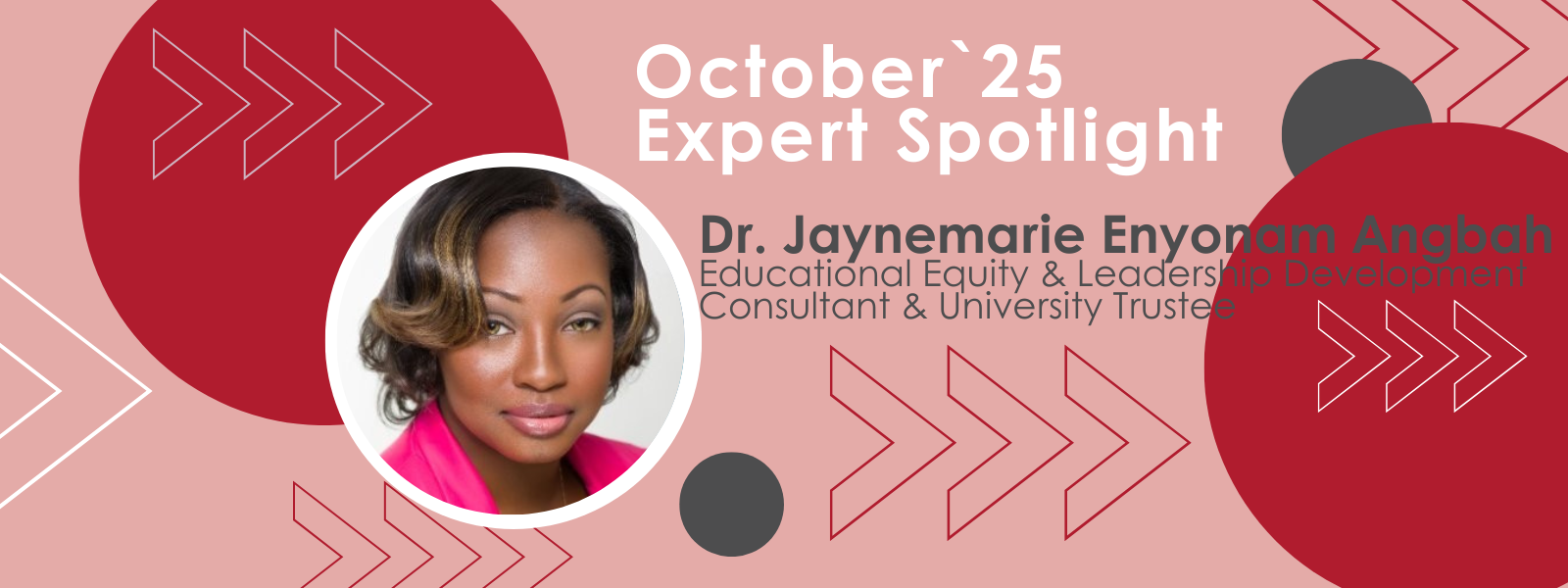
We're thrilled to feature an esteemed alumni, Dr. Jaynemarie Enyonam Angbah a true champion for educational equity with an inspiring 20-year career dedicated to transforming outcomes for marginalized youth. Jaynemarie is a visionary force, proven in leading organizational change and creating innovative programs. With a deep commitment to the intersection of research and practice, she specializes in strengthening operational systems and program quality. Get ready to learn from an influential leader who firmly believes that being an educator is not just a passion, it's a calling!
What does Experiential Learning (EL) mean to you, and why is it important? What would it look like to truly learn experientially? When considering Experiential Learning, I immediately think about the act of doing, that solidifies information in the learner’s mind. For many years our educational systems adopted a process of rote education where we were just dumping information into young people. Those that were able to capture it were really successful, and those that were not had less success and more challenges. We have to be thankful for scholars like Paulo Freire, who forced us to think about giving young people the opportunity to engage in information with all five of their senses, but most importantly, with their head, their heart and their spirit. It allows them to take information that they learned in one way and apply it in a way that becomes a part of their pysche. It is then in turn implemented into how they see and think about the world.
When thinking about Experiential Learning, we often go right to Maker Spaces,tinkering and movement but I think the experience of seeing something, relating to it socially and emotionally, aligning it to your social identity then giving young people the opportunity to say that this is something that I believe, and this is something that I want to continue exploring is the essence of Experiential Learning.
I also think a lot about the coaching and support that families and community members receive that allows them to pull that thread of learning through the fullness of children’s lives. These are the tools that we would give to caregivers to outline what was covered and identify ways that these skills could be reinforced at home. This practice would connect learning to the things that families do at home every day. It would lead to the creation of an entire ecosystem dedicated to the upliftment and education of young people. I think we often assume that communities don’t plug in because they’re busy and don’t have time and I don’t necessarily think that is true. I think you don’t get the most out of communities because we do not coach them on how to plug in and we do not give them the tools they need to actively engage with learning outside of the confines of the school.
So I think in the perfect world, it is not just about skill development and extending those skills outside of the traditional classroom, but also informing communities about how they can engage. It is also about having the faith that everyone is driven by a desire to learn and grow in whatever way makes sense for them and collaborating to educate our young people could be a powerful conduit for holistic communal learning.
What do you believe is the best first step towards advancing the future of learning? What is necessary to make it successful? This is a complex and loaded question. I think that we are not always effectively supporting our young people because we have not always created an ecosystem around our youth that has all the information they need to be active participants in their learning and engagement . We do not have systems set up to help us understand what’s going on with a particular child or family in multiple contexts/environments. I think one of the ways to fix this is to do a bit of community mapping. Consider: How do you pull in community entities as thought partners and support? I think we have created silos around learning where the school sits in its own space and has a lot of attention and supports but also restrictions around it. And then there are separate community based organizations of all types that pour into the same families but are often not given the same level of information. If we could expand our ecosystem to include places of faith, local businesses, really all community members and provide them with a consistent level of training, support and resources, we could really think about the individualized needs for each child differently and create a circle of support around children and families. This would share the load of what it means to serve children and families which is important because it is a heavy load and it becomes lonely when you only think about your siloed experience. It also would free up time for educators to be really thoughtful about lesson planning and development.
We still charge this one group of people, our educators, with being the experts on all things connected to youth.. I would argue that there are more people in a young person’s life who are experts in different areas and we get the most out of individuals when we allow them to focus on a particular skill set and flourish. This doesn’t mean that we do not require educators to understand relevant pedagogy, practice and discourse, particularly around socio-emotional learning and culturally responsive practice, but we can say they do not have to be the only experts in the room for all things related to a young person’s development on their own. They would have partners to look to and lean on.
Who is the most influential mentor you have had throughout your life? What qualities did they impart that you continue to embody in your work? I will always say my first prominent and important mentor was my mother. I lost my mum when I was very young but it always brings my heart joy when people see me and tell me how much I remind them of her. I learned about grace, intellect, work ethic, how you treat, see and engage with people and that I could do anything if I set my mind to it from my mum. She also taught me that ‘no’ was not an option, and that there was a place for me to be really nerdy and artistic. There are values that were inherent to Ghanaian culture around community, engagement and the freedom and liberation through knowledge and learning that were a tenant in my household. There were also messages about faith and your relationship with God and what it looks like to be called to something and extend yourself to others as an extension of God’s calling on your life. People would always comment on how nicely she dressed me or that I always looked put together, but my mother never commented on my looks. She only commented on my thoughts and ideas, and that matters because I care most about my thoughts and ideas now. My thoughts and ideas are the things that I pursue with the most rigor.
My second experience with mentorship was through Prep for Prep which is an organization based out of New York City that transitions high performing students of Color from NYC Public Schools to independent schools in New York and boarding schools across the Northeast. I respected the experience of Prep because it was equal parts learning and community building. We were coached and mentored by older students who were already in independent schools. They embodied the values of the organization which is excellence, integrity, commitment and courage. They allowed us to know that things were possible and there was room for all of us to thrive. I felt coached and mentored by my advisors and by the adults through the program who would check in on us while we were at our independent schools.
In college there was one professor who was the Chair of the History Department and her focus was around African American History. It was important for her to show up for the other students of Color on campus at a time where I was finding my voice, becoming an activist and really thinking critically about who I am. She was a thought partner and she would advise and then stand and watch but not impose. In the event that she was needed again, she would show up but would never overstep.
My next significant and important mentor was at Citizen Schools. I was early in my career and I would not have stayed in the out of school time space if someone had not said to me ‘you’re good at this.’ Keith Mascoll who was my Campus Director taught me so much about building community with youth and creating culturally responsive programming that allows children to feel connected and seen. I still coach and teach around relationship building, program design and curricula development based on the things I learned from him. Because of my work at the Wilson, I was asked to develop sessions and deliver sessions on differentiation and working with young people with disabilities. I would also say Heather Harding who was one of my professors at Lesley and also worked at Citizen Schools was the first person to introduce me to the idea of the intersection between education and therapeutic practice. She told me that I had a heart for social emotional learning and told me about a new program at Harvard that focused on this work and that I should think about applying. How many times in your life does someone say to you, you should apply to Harvard? But she meant it because she saw the quality of my work and she wrote one of my recommendation letters. The same is true for Adrian Haugabrook who also wrote me a letter of recommendation and who was the person who introduced me to equity and instruction which became a true tenant of my career.
Another important place where mentorship played a pivotal role in my life would be as a scholar/ practitioner. Jane Quinn who led the National Center for Community Schools at Children’s Aid Society is someone who has continued to be a mentor for me throughout my career. The things I learned from her around how to lead a team and be less visible so that your team could shine and thrive. . She has a quiet humility around her leadership. Another person who comes to mind from Children’s Aid is Vito Interrante who taught me that when you work in community based organizations, it is important for you to know every person in the building. From the woman on the corner who sells fruit, to the people who maintain the building, you need to know their name, engage with them and be present. I learned how to lead a team and allow individuals to have voice and also serving as a coach and mentor.. I also learned how to show up as a leader in times of change.
I have experienced mentorship in a lot of different ways, however there was a certain point when I became more senior in my career that I stopped receiving mentorship and it is something that I deeply desire. We always need development and it is just as important to mentor those who are leading as it is to those who are junior. As a Black woman and leader I’m still in search of mentorship, thought partnership and advocacy.
What are some of the greatest inspirations you have in the field of Experiential Learning? My strongest inspiration continues to be our youth and I count it as a blessing that I have been able to continue staying engaged with young people in different ways throughout my career. They have a keen sense of vision and have the courage to voice their needs and desires for their lives and world but I don’t know if we’ve answered their call. I think adults have a tendency to feel disrespected when they are pushed. But what I actually think is that this generation has been charged to think critically about the world that they’re in really early. The questions that they ask are from a place of being inquisitive and curious in order to figure out what they truly want and believe. Instead of us showing up with facts and information, we have shown up with critique. Now we have young people who do not have enough knowledge because we haven’t provided them with it. I continue to be inspired by young people who are in active pursuit of knowing more than is being shared with them and are pursuing ways to change things that they think are broken and ineffective.
I am inspired by the increased literature and research emerging around the importance of youth development professionals and the need to train and develop them. Research tells us that youth development professionals are one of the most impactful adults in the lives of young people but they are the least trained. They are the mission bearers of the field but they are not given the tools to grow and develop in the field.
I am also inspired by communities of faith who are looking at the challenges of our time and are reminding us to fight for what we believe in. I am inspired every day by all of the people who are broken and marginalized, and show up and fight because their faith and their hope is stronger than everything that the world has given them. They keep going on behalf of the communities they serve and on behalf of our children, and they will not stop. My hope is that all of the work I am doing is serving communities and families who are the most marginalized, and that when I am in a room, their voices are in the room with me.