
Julie Rogers Bascom: Expert Spotlight Throwback
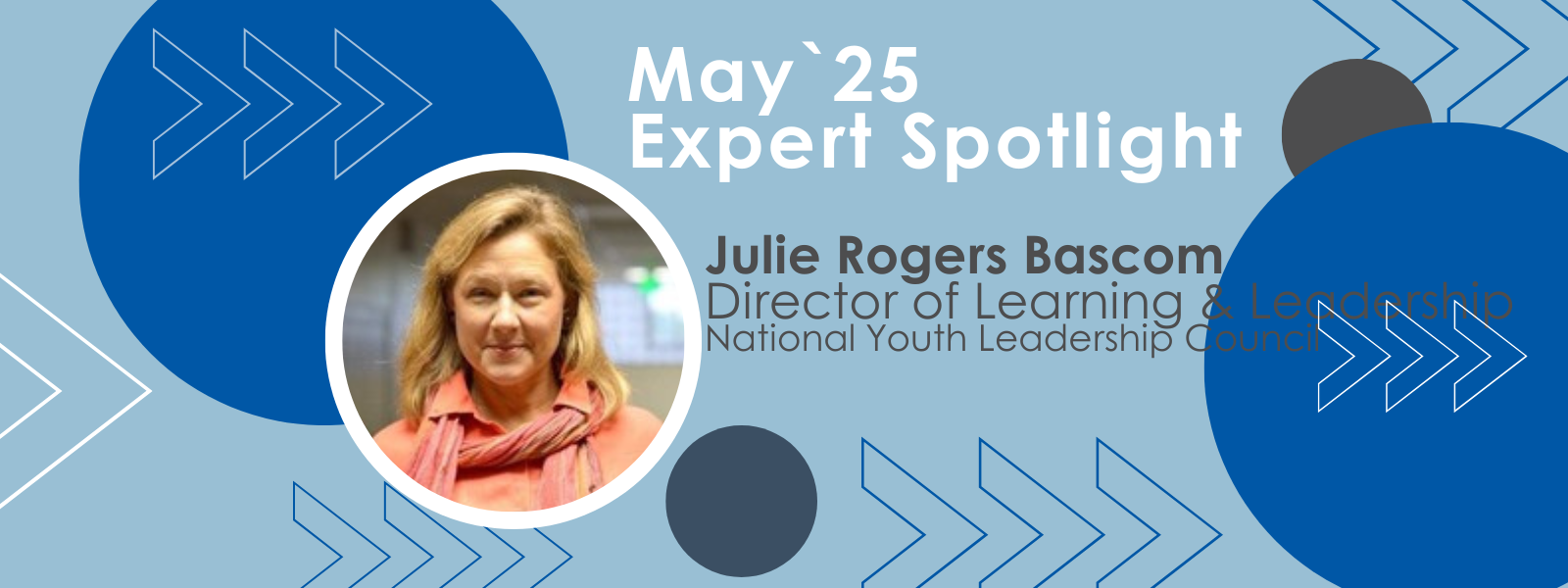
In this edition of our Expert Spotlight, we hear from Julie Rogers Bascom, the Director of Learning & Leadership at the National Youth Leadership Council (NYLC). Julie is a service-learning leader from Minneapolis, MN, with over 25 years of experience supporting youth workers, teachers, and young people in using service-learning to solve community problems. Her passion for helping young people become problem solvers was sparked by her own children's school experience, where every student engaged in service-learning annually. This aligns with NYLC’s mission to equip young people with knowledge, skills, and confidence to co-create a more just, sustainable, and peaceful world. NYLC's vision is a world where every young person engages in social action and is recognized as essential to civic society. Julie's work directly contributes to empowering young people and promoting service-learning as a strategy for leadership and community impact. We hope this edition sparks your own curiosity about what service-learning could look like in your community!
What does Experiential Learning (EL) mean to you, and why is it important? What would it look like to truly learn experientially? I can speak to Experiential Learning through the lens of Service-Learning. Service-Learning is a process, not just a project.Service-Learning is where you really build skills and apply them in real-world situations while addressing learning outcomes. This approach requires teachers to get uncomfortable with the messiness of Service-Learning experiences. You focus on how to tap into youth voice and offer them opportunities to explore, to dig into inquiry, plan and reflect, to talk to knowledgeable partners. It focuses on helping youth to understand what their talents, skills, and interests are, so they can use those to be part of the solution. For instance, a young person who really loves to draw might be able to design a brochure, while somebody who is really good at research could come up with the data. It's a collaborative collective action that is powerful, memorable and impactful.
It is not a stand and deliver, or a sit and get, kind of pedagogy. What is centered in Service-Learning is youth voice and connecting students to real-world situations where they are actively using what they are learning. It is about academic knowledge and civic knowledge, what students are learning and what they already know, and how to use that to address genuine community needs. It's experiential in that it's tapping into their lived experience and what they see as important.
As part of Experiential Learning, I think about academic concepts in real world settings, developing skills that are transferable and about reflection. The process is: here's a problem, let's research, let's understand perspectives, let's deliberate. There are decision making protocols as a natural part of the Service-Learning process. NYLC is not just about Service-Learning and the training we can do, it's about youth leadership and youth voice, because those are the outcomes we focus on. I think when you talk about Experiential Learning, people sometimes think that it's just about a project, or one experience. It’s also about those skills that young people are developing and how they apply to their world as they move through it. There's so much baked into the process of Service-Learning. It differs if a teacher would say, “and now class, we're going to go clean up the park.” That is great, important work and they would have a great experience. To take this a step further and think about Service-Learning, an educator could say “let's walk about and look at our community. What are its assets? What are its challenges? What do we need to do?” So it's just the difference between where you start and what your hoped for outcomes are for young people.
What do you believe is the best first step towards advancing the future of learning? What is necessary to make it successful? If students could experience quality service-learning experiences, we could be supporting a generation of changemakers - working to solve problems in their classrooms, schools, and their communities. Service-learning brings learning to life and offers the opportunity to grow engaged citizens - one of the tenets of public education. Service-learning builds skills, like leadership and communication, and strengthens competencies, like teamwork and perspective taking. And when done with fidelity, it connects deeply to learning outcomes. Service-learning is about a commitment to youth voice, which I think is at the center of education, in school and out of school.
We often notice that it's a certain type of young person that have access to these service or service-learning opportunities. I believe greater access to Service-Learning would help address an equity issue. When done in a classroom or in a group setting, all young people get to be involved in it. I think there are a lot of young people that are not asked to be problem solvers, and it's too bad, because they sometimes come up with the greatest ideas.
So what would be another good step in advancing learning? To me, it is looking as teaching as Youth-Adult partnerships. I think that lends itself to student agency and true Youth Voice. Having young people say, “it's my job to learn”, instead of it's the teacher's job to teach me, I think that's a real different mindset for teacher, for parent, for learner. It is an approach that all young people can be successful in. We worked with a group of young people who are developmentally disabled, many of whom were non-verbal. They would go to a local playground but there was nothing for them to do because it wasn’t set up with accessible equipment. In their process, led by the teacher they were able to propose a plan to get accessible playground equipment. This work was guided by the teacher and the teacher facilitated the execution of the plan. They helped write the letter and make statements to the community. This to me is a perfect example of that Youth Adult Partnership.
Who is the most influential mentor you have had throughout your life? What qualities did they impart that you continue to embody in your work? In my work, I do a lot of workshops, teaching of teachers and facilitating conversations. When I think about mentorships, I have three people who come to mind. There are times where I think I need to wear my “ Cathryn hat” or “ Jim hat” or “Nan hat.”
Jim Toole has been instrumental in expanding Service-Learning for over 40 years. He has done a lot of work around the world on Youth Voice, youth empowerment and youth entrepreneurship. He is always thinking outside the box and always leading with his heart and with possibilities. He has done a lot of work around Appreciative Inquiry and seeing the positive, asset-based policy change. He uses what's working right and applies what's working right to fix what's not working. A reminder in asset based change making.
The other person who is a Service-Learning leader in America and Internationally, is Cathryn Berger Kaye. Her workshops are incredibly engaging and focused on connecting with people. One of the things that I think is important in leading workshops and providing services to people, especially to folks in education is around true relationship building and she's got a natural energy for that. I think this is crucial to supporting teachers.
The last person is my dear friend Nan Peterson. I connected with her when my kids went to a new school after a move to MN, and she was the one who really believed in me, led with me and partnered with me with my service-learning work. When Nan says to me, “I'm proud of what you're doing,” it's like a stamp of approval.
What drew you to your organization's mission? What drives you to activate this vision? The work that NYLC leans into is critical to where we are right now in our world. Young people want to be engaged and as adult allies, it’s our responsibility to partner - REALLY partner with them so they can exercise and grow their civic muscle. We just recently revisited our mission and vision. We use Service-Learning as a strategy to get to Youth Voice and to youth leadership. We support teachers, out of school time professionals, and the adults in our young people's lives to support and help them build their leadership skills and access their voice. As the saying goes, young people can be leaders in the future, but they also are leaders right now. We need them to practice, we need them to make changes, so we can’t wait.
Here’s the power of service-learning: I was told about a project where young people noticed that after a flood that impacted their school, there was mold in one of the classrooms, and nobody was doing anything about it. They took it to the Principal and the school board, and made sure that parents knew what was going on. They really facilitated the process where people needed to be told about some of the bad things that were happening which is great leadership practice and impactful.
Another project I heard about was in a 7th grade class where they were addressing the human impact on the environment. They saw there was a lot of road salt going down the storm drain, and learned that the water in the storm drain goes into the river, and the river behind the School was being impacted. From this initial finding, they decided the school needed to stop using salt. They presented the problem to the custodians about why they shouldn't be using so much salt. The custodians then talked about how they measure the salt and keep track of it and about how there was a real method to what they were doing to try to curtail the impact. The custodians started asking the students questions about what would happen if they didn’t use salt at the school in icy conditions. After discussing the possibility that someone could fall and get hurt in such a high traffic area, the students and custodians started thinking about how one of the greatest impacts on the water quality is your everyday homeowner throwing a bunch of salt on their driveway. So the students changed the direction of their project and created an awareness campaign aimed at all of the families at their school. This example shows how multiple, diverse perspectives when brought together in a true partnership can create something incredibly valuable. That is civic engagement.
What is a student-led initiative you have seen that has successfully disrupted a flaw in the education system? How can we best position students to be changemakers? One of NYLC’s programs that I'm really excited about is called Youth As Solutions (YAS). It's a Service-Learning program where adult leadership teams and a group of young people meet monthly to work on an issue that they are trying to address. There are four different focus areas: education, community health, civics and democracy and environment. Young people and their adult leader apply to be part of this cohort. The adults are learning about the Service-Learning process and how to really support young people and the young people are learning how to develop their leadership skills. What we're seeing is the camaraderie between young people broadens their perspective, and it is a way to build skills for the adults and help them understand how to facilitate and how to ask young people to truly engage in their work.
What are some of the greatest inspirations you have in the field of Experiential Learning? I'd like others to know more about some programs that are working on youth voice, youth leadership and youth changemakers. I encourage your community to check them out.
Communities In Schools: they're doing really great push-in work to support young people who are struggling with academics, attendance or behavior. Their support model is data driven and effective for some of our learners.
League of Women Voters: the work that the League is doing is all about making democracy work for all. And that's really at the heart of service-learning - becoming civically engaged.
All Children Thrive: they are engaging young people in making community policy change which is really meaningful work.
Minnesota YMCA's Respectful Conversations In Schools: these workshops aim to teach teachers and young people how to have conversations around divisive topics. the protocol encourages youth to speak from their own experience, listen carefully to others, and ask questions of genuine interest There is a focus on the skills of discussion and deliberation, not about winning or losing but rather trying to listen to understand.