
Dr. Rudy Ruiz: Expert Spotlight Throwback
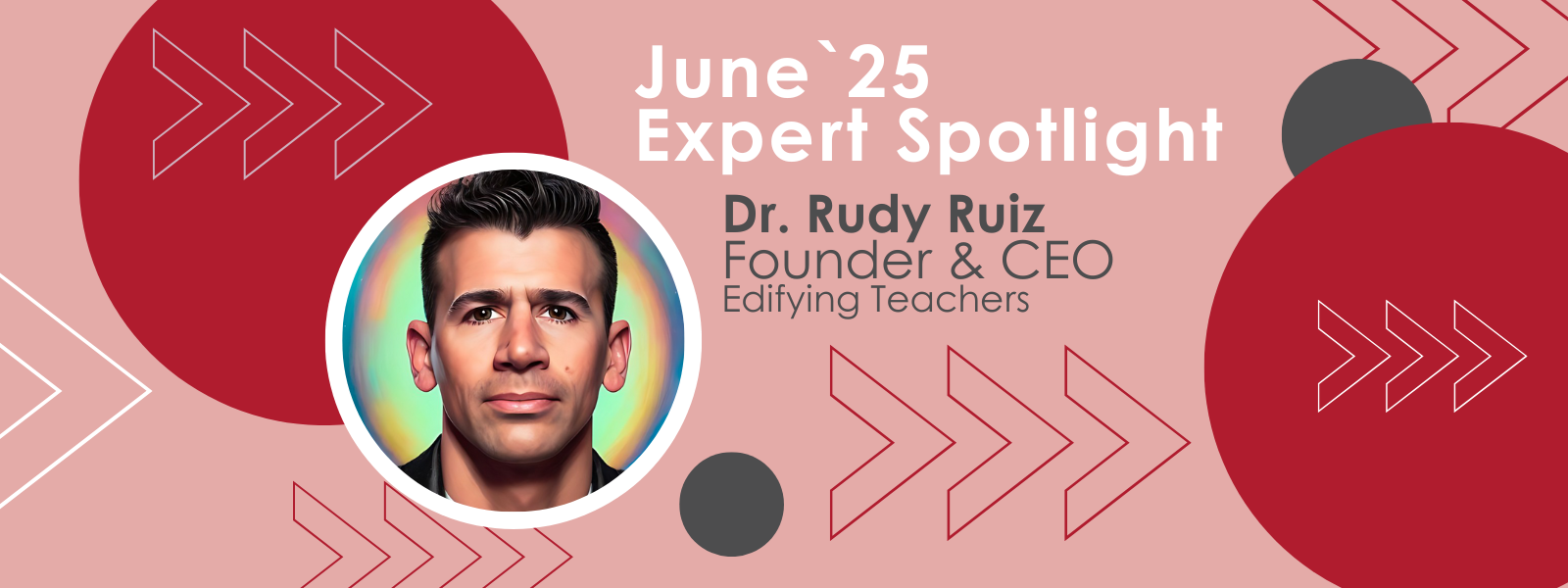
We are thrilled to feature Dr. Rudy Ruiz, a true visionary and the driving force behind Edifying Teachers. As the founder and CEO of this groundbreaking organization, and a distinguished member of the Education Leaders of Color (EdLoC) national coalition, Dr. Ruiz has dedicated his career to rehumanizing education through the power of connection. His celebrated background as a teacher and school leader, coupled with his doctoral research from Johns Hopkins University, has led him to create an evidence-based solution for supporting and retaining educators nationwide. We are incredibly excited to share how Dr. Ruiz's work with Edifying Teachers is forging a global network of diverse teacher mentors, addressing critical teacher shortages, and truly transforming the educational landscape for the better.
What does Experiential Learning (EL) mean to you, and why is it important? What would it look like to truly learn experientially? I think the Learning Sciences have shown that students learn best when they're doing and when they are experiencing. I think that there are important connections between both the student experience and the educator experience and humans' hardwired need for a sense of purpose, a sense of belonging and a sense of support. And so I think there's a lot of really important connections that we overlook as we get to the work of doing education.
What do you believe is the best first step towards advancing the future of learning? What is necessary to make it successful? I think at the heart of it is mentorship. I think there is a major gap in the field when it comes to the importance of connection. At Edifying Teachers, our mantra is rehumanizing education through the power of connection. We believe in trying to model and foster multigenerational mentorship. Often in the field of education, people hear mentorship, and they get nervous or uncomfortable, because there's been negative connotations largely put around mentorship. The connotation has been that these students or educators have a deficit or are not succeeding, therefore they must have a mentor. Our core work when it comes to the education workforce has been introducing new ways of thinking, talking about and doing the work in terms of language. We know that throughout human history, for folks to grow into any space, they need high-quality mentorship, and that's what we're providing.
We have a handful of evidence-based, alliterative frameworks that we use to help people have a common language when it comes to facilitating a community of support for the whole teacher journey. One of those is the 4 A’s framework. Especially for underrepresented students, they're not often told that they could be a great teacher someday. So at the beginning of our 4 A’s framework is Awareness. Next is Apprenticeship, where teachers and those interested in teaching are supported in their exploration of what the field really looks like.
The third A is our core work which is Adequate support. We know that once teachers come into the field, they typically will get an assigned mentor which we refer to as mentorship 1.0, because it's often the person down the hall who was assigned to guide you but may not be someone you identify with or who is able to fully support you. And our final A is for Advancement in the profession. We've had opportunities in our early years, to be able to support efforts around the country in each of those spaces.
When we talk about multi-generational mentorship, we believe that not only do middle school students want, need, deserve and benefit from mentors, but so do high school students, college students, early career educators, experienced educators and school leaders. We have positive feedback from seeing the whole person at whichever age and stage they are at.
Who is the most influential mentor you have had throughout your life? What qualities did they impart that you continue to embody in your work? I've been blessed to have a lot of great educators and mentors over the years at each stage of my own journey. A couple of the mentors that I don't give enough of a shout out to are the ones who have not only helped me develop as a professional, but have also contributed to helping Edifying Teachers come to life. The folks who have given of themselves through experience, time and guidance in the field have really helped to make this organization happen.
One person who concretely affirmed my potential at two key junctures is Barbara Fishman. Barbara approached me with an offer to become an acting Assistant Principal, my first major move beyond the classroom. I didn’t feel confident or ready for the opportunity, so I asked her to call me back in a year and see how I had progressed. She called me back a week or two later and said ‘No, it is going to be you. We will figure it out together, and I will show you the ropes.’ Then again years later, having become a school and district leader, I wanted to bring Edifying Teachers to life. Barbara came back to me and said she wanted to contribute to helping grow this important work, again embodying the full spirit of mentorship.
When it comes to mentorship and something we focus on with our model is that there is a difference between coaching, mentorship and sponsorship typically. At Edifying Teachers, our model incorporates all three elements. Our Mentorship 2.0 (personalized mentorship by a well-matched mentor) has evolved into Mentorship 3.0, in which mentees actually have the agency to select their mentor. We are helping build the social capital of our mentees, while we are also paying our mentors and providing true holistic support.
Data-driven results are instrumental in helping to share success with outside stakeholders. How has your organization been able to reflect your results effectively? What challenges have you encountered in the process? I had alluded to other alliterative aspects of our framework. Those are our 4 M’s and 3 C’s. The 4 M’s focus on what works for helping make sure that humans, not just students and or teachers, have a sense of self efficacy (the confidence that they can be successful). We talk about the importance of Modeling, Mindset, Mentorship and eventually achieving Mastery.
I believe our secret sauce is our 3 C’s. As I spoke about earlier, the notion of social capital is very important. Unfortunately, we know from the research that education is not always the great equalizer, because what's important in terms of being able to get a strong start on a career and progressing in a career is connections. We are very attentive to that, and so two of our 3 C’s focus on that specifically. One is Career Navigation, making sure that people have an opportunity to be asked and supported in understanding what supports they need. What does it take to explore this other aspect of an education pathway, etc? Next is ‘Collaboration with Connection.’ When we're making these connections between mentors and mentees, we don't want the mentor to feel like they are the end all and be all for the mentee. When they are listening to their mentee's needs and interests, they may recognize a subject area that's not their area of expertise. We ask them to think about introductions and connections to resources they may be aware of. Then the third C is Culturally Sustaining Mentorship. As these different efforts are happening nationally, we want to make sure to grow each community of educators and have them reflect the student population. Oftentimes our educators end up being the first Latino in the building, or the only Black teacher in the district. We want to make sure that those educators have a space to discuss and be supported around that.
We are now working with six partners in five states. What I've been able to orchestrate and do through this work is to not only demonstrate the value of mentorship and personalized mentorship and culturally sustaining mentorship but also build a network. We just completed a very streamlined platform so that our partners are provided with a thoughtful way of connecting with community and contextualized, tailored mentorship. We now have the capacity to deliver personalized mentorship at scale. We point out in our training that our mentors are going to be learning from their mentee as well. This is a two way relationship. We have used evidence based data to develop an actual matching algorithm. However, instead of using an algorithm strictly, once a mentee creates their profile, they get an instant match of three prospective mentors. Then they get to look at their matches and share who they would choose and why. This creates immediate agency and buy-in.
What is the most successful and/or unique example of educators and mentors working together to create an impact on students that you have seen? Johns Hopkins University School of Education in Baltimore is one of our partners. They were finishing up their first cohort of a new teacher residency program called Teaching Well that we support. With our approach, I was able to be here on the ground and in person to build human connection and facilitate conversations. Then, since this is a STEM focused program, we focused on those connections. We have a science lead who is a Black woman from Texas and a math lead who is a Black woman from Indiana, both of whom we were able to Zoom in to the conversations. The young adults in the residency program who have moved to Baltimore to serve Baltimore City Public Schools students are now able to be in this open, safe space and truly answer the question, “How is it going?” The residents - which include professional scientists and researchers who are making a career transition - are then connecting with experienced educators who have been in similar classroom settings and are able to ask them how to teach a particular concept effectively. We are able to remind these soon-to-be teachers that we want to provide them with high expectations AND high supports, and that we want them to provide those to their students as well. We’re able to take challenging conversations and turn them into opportunities. We remind them that while it is important to be a part of a professional learning community in your building, collectively identifying effective ways to connect with students, including connect with families and others. We really encourage our educators to stay the course, be curious, figure it out, and since they are young professionals they are coming back to us saying that encouragement is really helpful and insightful and help creating successful engagement with their students.