
Constanza Azzolina: Expert Spotlight Throwback
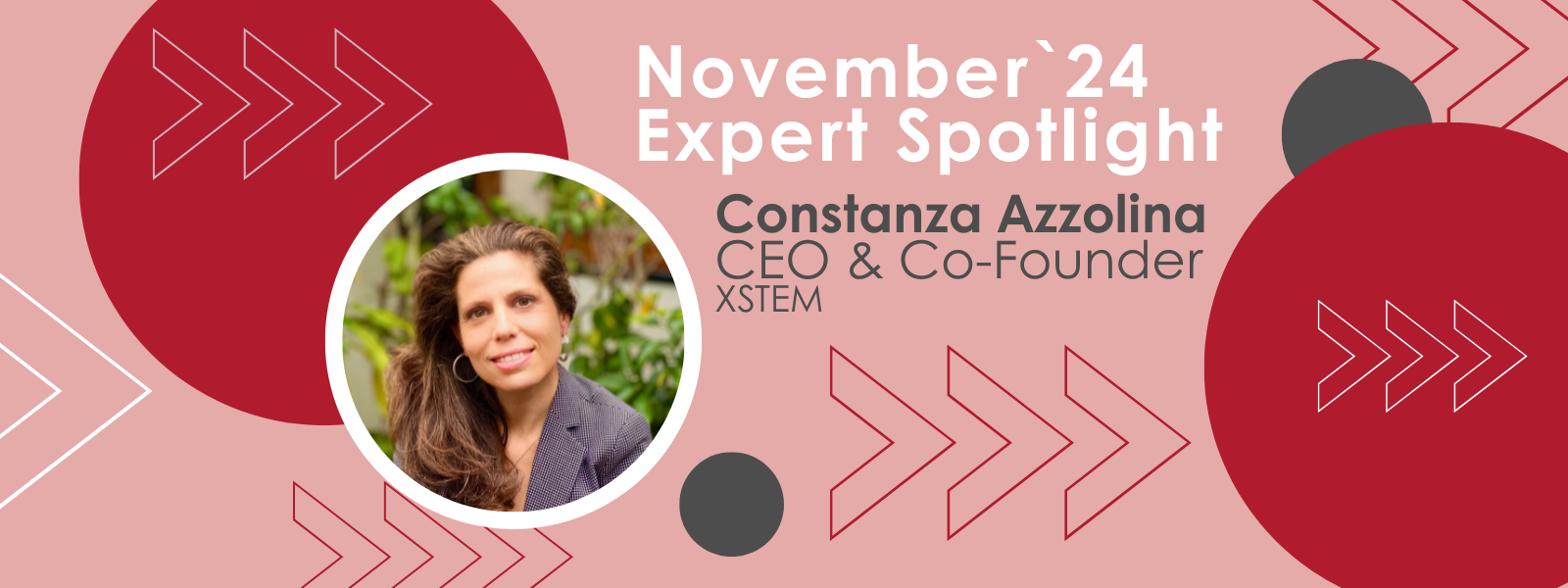
We are rereleasing a spotlight highlighting one of our Learning Network members, Constanza Azzolina. We have had the good fortune of being connected to her through her incredible dedication to STEM education in Latin America. Constanza’s passion for this work is truly contagious and we are thrilled to have you hear from her.
Constanza Azzolina is an advocate for STEM education towards a sustainable future, with a large experience implementing education programs for adults, educators and youth. After leading cultural change initiatives in large industrial and technology corporations, she dedicated herself to designing and executing a global network of after-school STEM programs, impacting thousands of children across Latin America. She co-founded XSTEM, an organization promoting high-quality STEM education in both formal and informal settings. Her focus is on inclusivity, sustainability, and capacity building for educators, aiming to provide equal opportunities for all students. Constanza Is a member of international networks of STEM education specialists, such as the Network for Emergent Socio-Scientific Thinking (NESST) of the Smithsonian Science education center.
What does Experiential Learning (EL) mean to you, and why is it important? What would it look like to truly learn experientially? Experiential Learning is an active way of learning, where access to the phenomenon, the object studied or direct experience, from the body and with a strong cognitive involvement, is involved in what is being learned. It is the opposite of passive learning, of reading, seeing, listening, and not involving the body, manipulation or direct experience in the process. And for this reason it generates a different result, and more possibilities of “engaging” and motivating students, who feel part of the process and involved, and puts much more into play than when listening, looking or reading. And this is one of the keys to applying what is learned, as opposed to a memorized or automatic reproduction. The emotional, physical and cognitive connection with the process undoubtedly facilitates deeper learning, which puts into play understanding, thought, and the potential for developing skills such as scientific observation, narrating a phenomenon, generating a consensus in working with others, or decision making.
In an after-school program for elementary School children, we carry out inquiry based science activities that involve manipulation and direct experience. One sequence sought to help students understand the growth and development of plants. Both slower and faster growing seeds were planted, to exhibit short term results and results throughout the school year . They directly managed the resources to keep the plants growing, and how to ensure that the supply was not interrupted. Some projects that emerged to solve real problems were the creation of a school garden equipped with a prototype of an irrigation system for the school plants during the holidays so that they do not dry out and continue to develop.
What do you believe is the best first step towards advancing the future of learning? What is necessary to make it successful? I believe that the future of learning cannot lose sight of inclusion. We can do a lot from the point of view of innovation itself, of technological and the didactic innovation but if this does not reach the majority of humanity and does not strive to include populations that have historically been underrepresented in technological development, then I believe we are falling short.
The real challenge for the future of education is to achieve inclusion, and to do so as quickly as possible, so as not to deepen the gaps in opportunities, while being respectful of local and community realities. In this sense, technology and the enormous development of Ed techs can be an ally, but it requires vocation, intention and financing, and the continued support of governments, having education as an ally of positive social change.
Some of the key things to look at to achieve a more inclusive future for Education come down to the materials and development available to our educators in all parts of the world. First, teacher training and curricular standards in developing countries should be updated taking into account active approaches and mindsets that help develop the next generation of responsible citizens. Next, standards that are more advanced are used as a beacon, and then are connected to local problems and challenges to guarantee they make sense for that community and reality. An example is the NGSS, which is always being revised and updated.
Educators should have the opportunity to develop approaches such as experiential learning, which puts the student at the center and takes into account that each one learns at their own pace and has their own styles. To be able to successfully carry out this work, educators should have access the free and available high quality content and a community of practice, where they can get connected with other educators. Through this community, they are helped to develop the ability to search and select quality sources and materials. In order to be successful with this, they need to have connectivity and equipment, just like their students in educational spaces. While this seems obvious, in places like Latin America it is not guaranteed, and many times educators only have their personal cell phone to manage their educational processes.
Therefore, community, connectivity, and equipment are key to being able to take advantage of the benefits provided by the digital world and the educational community on a large scale.
Who is the most influential mentor you have had throughout your life? What qualities did they impart that you continue to embody in your work? My greatest influence was probably my mother, who was very important in studying Science and giving me access to materials to manipulate and always being available to explain my doubts.
My mentor in my professional life is Melina Furman, a biologist, educator and specialist in Science education, who motivated me to continue to go deeper into my vocation and purpose and Co found the project -XSTEM- to the next level. As a mentor, she always found a way to center my interest and experience in her approach. She listened to me and let me know when my excitement about an idea was visible, and encouraged me to go down that path! She gave me assertive feedback on what she considered was right or may be improved instead of judging me. The activities she proposed were fun and contained some movement, even play. This generated engagement, and a deep involvement with the proposal. She was a very positive person, she always encouraged you to continue, to delve deeper into what interested you and motivated you to continue the process. Meli passed away on September 6, but her approach with me will always have a lasting impact. I think Meli encapsulates the role of a mentor, being a beacon that shines on you but lets you follow your own path in learning. You knew she was always there when you needed her, but she gave you the autonomy to make your own decisions and look at you without judging.
If no obstacles stood in the way and you could design the future of education as you see fit, what would that look like for educators and students? I would like to answer this from the point of view of integral STEM education, which I believe is the future of education.
Here is my ideal vision: Students have opportunities to learn in formal educational spaces as well as non-formal ones, where they make decisions about different extracurricular activities, beyond the curricular requirements. Education is genuinely comprehensive. Children are educated without losing sight of the socio-emotional learning. Schools are spaces of connection with nature, where Students learn in connection with ecosystems, which they learn to value and care for at all times. Education is connected to real problems. Is active, experiential and experimental, which makes it more like a workshop, open office spaces, places where Students can learn alone, with pairs or in groups, mentored and guided by adults. Students participate in the generation of solutions for Education, especially using technology, because they may be really proficient with Technology and add value at all times. The community enters the classroom to contribute to the educational process.
What drew you to your organization's mission? What drives you to activate this vision? XSTEM's mission is to support the next generation of children and Youth to develop the skills they need to be changemakers in a challenging world, and towards the sustainable development goals. We work with educators to help them so that they can accompany their Students to get there.
XSTEM arises from the enormous need to make education more active and connected to real problems, and to bridge the gap between those who can finance additional training opportunities outside of school and those who cannot. It also aims to fill a vacant place in comprehensive education. In Latin America we still see a lot of traditional education, focused on discipline, theory and memorization, even in an era where technological advances and educational reality are so different from when these models were created.
What was your earliest experience with hands-on learning? Did that inspire what you do now? My first life experiences were as a child, in the natural environment. I lived a few blocks from the Paraná River, in Argentina and thanks to my mother, who studied a scientific career, and inspired me and gave free rein to my curiosity. This left a deep mark on me, to the point of directing my current purpose. I feel that direct contact with nature and the phenomena, with mentoring and guidance, nourished my curiosity and got engaged with learning.
And here is the connection between my personal experience and XSTEM. In STEM education Science gives us a fundamental foundation and basic skills to scaffold more complex learning. Engineering connected with Math is essential to design solutions based on that scientific knowledge and aiming to give solutions to real problems. Technology is an increasingly powerful tool to enhance processes and go further. That is why I believe that integrated STEM education, combined with active approaches as experiential learning, is a key to advance towards a necessary innovation in education. To hear more about my approach, I share my talk at El Mundo de las Ideas.