
Dr. Charles Carter: Expert Spotlight Throwback
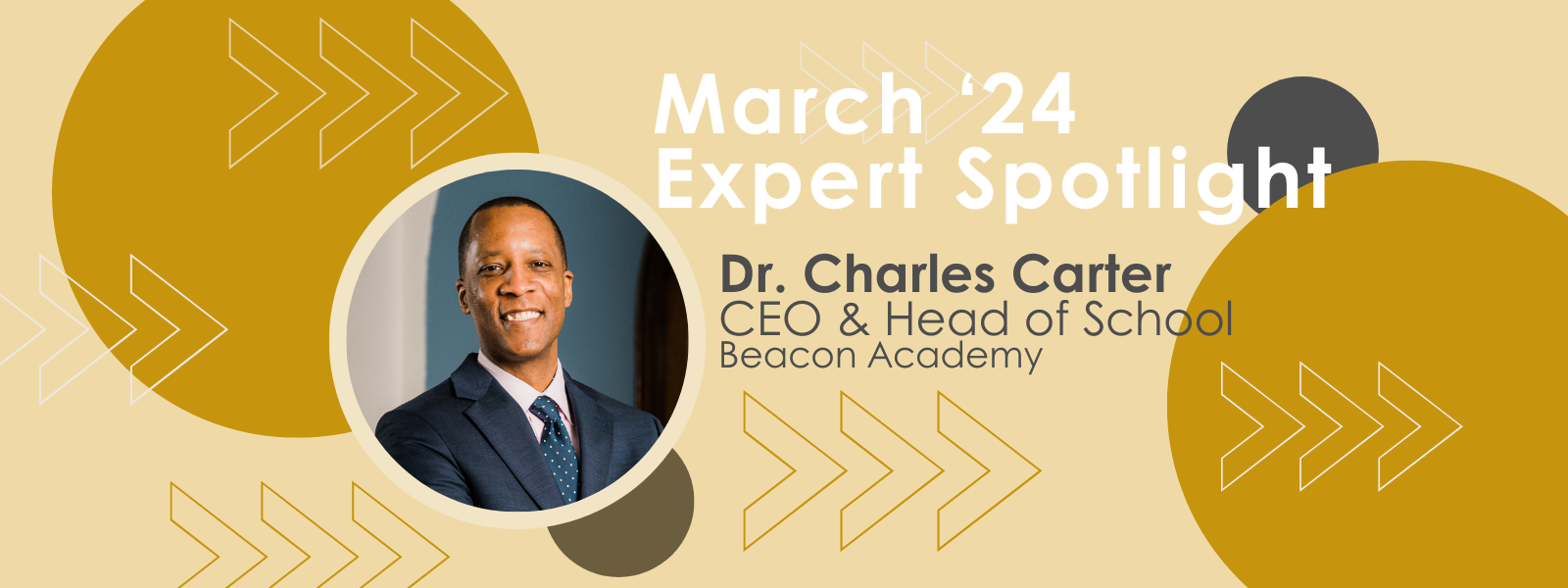
Today, we are rereleasing our interview with Dr. Charles Carter. Embarking on a mission to reshape the landscape of education, Dr. Charles Carter emerges as a stalwart champion for social and economic justice, channeling over two decades of commitment into uplifting Black and Brown communities. With a career deeply rooted in addressing the challenges faced by children and families with limited resources, Dr. Carter intertwines curiosity, humility, passion, and humor to catalyze meaningful change. Upon interviewing him for this edition of the Expert Spotlight series, we can certainly attest to that.
Dr. Carter's journey includes pivotal roles, notably as a Founding member of the leadership team for Project Evident. His co-creation of the virtual learning program, a Talent Accelerator, underscores his dedication to leveraging evidence for transformative impact. A graduate with a Ph.D. in Social Work from Boston College, Dr. Carter's academic foundation complements his innovative leadership style. With roles such as Deputy Director and Chief Strategy Officer at the Center on the Developing Child at Harvard University, he has played a crucial part in building the capacity of individuals, organizations, and systems to foster innovation.
In this illuminating interview, Dr. Carter delves into the essence of experiential learning, drawing from his rich background as a musician, athlete, and an activated community member. His forward-thinking vision for education, grounded in genuine student-centric practices, resonates with his current role at Beacon Academy in Boston where he is currently the CEO and Head of School. Dr. Carter's mentorship transcends traditional boundaries, embodying a holistic approach to hands-on education that echoes the transformative power of genuine, student-centered learning.
What does Experiential Learning (EL) mean to you, and why is it important? What would it look like to truly learn experientially? I would say it means, how do you take the knowledge and information that you have absorbed and use it in a real-world context. In my opinion, obtaining knowledge is only useful if you can apply it. Ideally, the application not only benefits you but also improves the individuals and communities that you are invested in.
I'm sure I’m biased, because I prefer hands-on learning; the joy and struggle of figuring things out. Asking questions like, ‘What does it mean?’ and making room for different interpretations and applications based on the context you are working in. That's exciting! The opportunity to learn is infinite.
I’m a former musician who grew up playing trumpet and baritone horn from middle school through college. For me, that was a great Experiential Learning experience. You don’t get to become a great musician by reading about it…you have to practice and fail and try again over and over again. The same is true for me playing sports. The practice and game situations provided immediate feedback on my progress. What worked, what didn’t, and where did I need to focus. Learning new skills was exciting and frustrating. But ultimately, learning by doing was the thing that excited me. In high school, I participated in a club that paired high school students with elementary students to develop positive social skills. The club was another hands-on experiential learning opportunity. It was important to not just talk about social skills but to practice different situations to make it real for the students. Role playing how to navigate difficult situations improved their ability to remember what they learned from each other and us as high school students. Those [experiences] were really fascinating [and] interesting to me. The least interesting aspects of my education were the classes that were just lectures, I tuned them out; I couldn't do it. So I've gravitated in my career to places where I'm a practitioner fully immersed in the work. I thrive in figuring out challenges with people; celebrating successes that are big and small; and learning from it all.
What do you believe is the best first step towards advancing the future of learning? What is necessary to make it successful?
[At Beacon], we really believe in being student-centered, meaning that we are paying attention to what the student needs to get to their goal versus what I [may] need as an adult to achieve my goal. When you talk to people who work in education, they [often] say they are student-centered, but when you start looking at some of the policies and practices and the way they do things, you [realize] that it’s not always about the student. It can be about what's convenient for the adult, institution or system.
If my premise is correct, one place [to start] is [asking], ‘How do we encourage and support curiosity with the adults in their day-to-day practices?’ Can you move to a place where you can truly stop and critique [your] routine to see if it supports what's in the best interest of the student? Can the review happen in a way that doesn't feel like you're being personally criticized? Are you given the space to learn? Some adults in the education space are challenged by structures that get in the way of learning. Others have a mental model that believes that learning moves in one direction from educator to student. Being an educator and learner is hard work. There are a lot of competing agendas and concerns, so it is critical to create an environment where learning (for adults and students) is intentional. It’s important to have space to pause, reflect and assess, did this approach work? Did it not? How would we adjust it? How do we get input from the students? Where do we want to test a new idea/method/model?
Who is the most influential mentor you have had throughout your life? What qualities did they impart that you continue to embody in your work?
I am a big believer that there are mentors from all different aspects of your life and along your career journey, and I take full advantage of that, and I like to give back in that way as well. I would say the things that they’ve all had in common is that they see me as an individual. They validate the struggle of trying to become whoever I want to be: whether it's a musician, an athlete, a professional; they validate the bumps and curves of my experience as a Black man trying to find my way. They allow me to be vulnerable and to express my fears and challenges. They push me to move beyond some of those [fears] and figure out a way to move forward. And they're there to celebrate the things that work and open doors to new pathways that I might have never thought about.
One of the things we talk about with the students at Beacon is that part of the value of the 10-year [commitment] is that there is a community that stays with you. None of us are successful alone; we all do this together. So being able to not only find and build that community but, going back to the agency part, is feeling comfortable asking for help, accepting that help, and knowing that it’s not a flaw but actually something we all do. As you might imagine for teenagers, that's like, ‘Yeah, I don't want to stand out like that.’ Or as a student of color in a predominantly white wealthy institution thinking ‘I don't need any more attention or people feeling like that I didn't deserve to be here.’ So how do we keep reinforcing that this is how people operate, whether you are wealthy, not wealthy, black, white, Latinx, whatever. It is how and who we move with that helps us find our way.
Can you describe how Beacon incorporates experiential learning beyond the classroom and into the full learning environment?
We actually think about hands-on and experiential in a few ways. One is in the intentional small size of our classrooms. We tell students when they get here that there is nowhere to hide. You have to be an active participant in your learning. You have to be able to take risks, to talk in a large group about what you heard, how you interpreted it, and then how you want to express it again. And you've got to do that in the context of then receiving feedback from the adults and your peers. For us, that's a very hands-on experience, because it is a skill they need to bring with them to high school and beyond. We want to build their capacity to be agents of their educational journey, and that starts with the practice of understanding who you are, how you like to learn, challenging yourself, being able to challenge others, and doing that in a lot of different environments.
So, that's one aspect of it. The other is the exposure. We take them to visit independent high schools, so they actually see the campus, experience a bit of the classroom environment and where possible, interact with the students who are there. They can visualize whether this is a place they can go once they're done at Beacon. They have an opportunity to think about, ‘How far is it from home? How does that feel for me and my family? We [also] expose them to a lot of sports’. One of the first things we do, whether you're an athlete or not, everybody runs. Running is not just physical exercise. It represents the ever present need to stay persistent as agents of their educational story. One of the messages for the students is that, ‘There are going to be things in life you do not want to do, but that you have to do, so how do you move through it. And so they run from July until October, and then we do a 5K together as the culminating event. We teach basic skills in soccer, swimming, crew, lacrosse, golf, basketball, skiing—all of those are really opportunities to learn something new, to take risks, to learn something that you may not even know you had a passion for because you just hadn't seen it done. All of this is really important, because we emphasize the value of getting out of your comfort zone and being able to really advocate for what you need. You've got to be able to move from the backseat to the passenger to the driver seat.
How do you encourage and empower students through this holistic academic journey? What happens when you meet a student that may be struggling to challenge themselves?
We do a lot of work up front. From the open house through the interview, we talk about what [the students] are committing to. First thing to know, we are a 10-year program. This is not a short-term intervention. We are going to be with you from 13 to at least 23, and there are a lot of changes that you're going to go through, that your family is going to go through. Are [they] willing to do that? We're committing to that too; it's not just them. We have alumni come back and talk to the students in the Academy year about their experience at Beacon; where they are now in their journey, and what lessons are still resonating with them today. We try to set the stage for students and partner with their families to say this isn't just about the student; you're on this journey too. We have to make sure we're on the same page.
When students first arrive at Beacon, we jump into activities to get them out of their comfort zone. We emphasize the importance of being comfortable about being uncomfortable. One of the first topics is about first impressions and how you show up. We practice introductions considering things like, where do you stand, how much eye contact is too much, how firm is the handshake (if you are shaking hands), and how do you introduce yourself. The student’s first reaction is typically, ‘this is so weird. Why are we doing this?’ First impressions are important, and part of them transitioning to a new and unfamiliar environment of an independent school is [that] they are going to be introducing themselves to a lot of different people. What do you want them to know? How do you want to show up (authentically)? We talk about the challenges that are ahead and the importance of advocating for what you need, asking for help and being an active learner. We have a strong community of adults that support the 10-year journey. There are the student’s families; teachers, advisors, mentors,tutors, alumni, and community and school partners. The alums play a significant role in the experience of students in their first year with Beacon. We have alums that offer advice, teach co-curricular classes and help students as they complete applications for high school. Some of the early struggles for students are around managing the academic workload. There are periods throughout the year that students say, ‘I don't know if I can do this!’ This is a place where the support of the Beacon community is key. We reinforce the message about the value inherent in the young person. Particularly [because] the majority of our students are students of color, and they can be dismissed in other contexts and environments, we say, ‘no, you are here, you are smart, you are valuable. How you apply that is the place you can control, but know there's nothing you have to prove here. You need to keep pushing through the places that are going to be hard. And it's not just going to be hard in school; it's going to be hard in life at different stages. So let's get that practice in now.’